
Top Signals
History does not repeat...but sometimes it does rhyme

The market top signals are getting harder to ignore.
Landmark IPOs are one such top signal.
In May 1999, Goldman Sachs, the ultimate Wall Street insiders, ended a 130 year history as a private partnership and listed on the New York Stock Exchange. The tranche sold to the public raised $3.7 billion and valued the investment bank at approximately $30 billion at the time.
This was back in the days when $30 billion was a lot of money.
Seven months later, the US stockmarket topped out (in January 2000) before entering a three year bear market that saw NASDAQ lose 82% peak to trough and the broader market lose ~50%.
This week SpaceX got its initial public offering (IPO) price away at $135 per share. The stock opened yesterday at $150 and surged to close its first trading day at $160.95, achieving a market valuation of roughly $2.1 trillion.
According to a quick read of the SpaceX IPO prospectus:
the valuation is almost 100x revenue.
the company made an operating loss of $2.6 billion last year
it’s not just a rocket company, it’s a high tech engineering conglomerate with rockets, AI and internet solutions…you can’t even say that the sky’s the limit…there are no limits!
Total addressable market is stated at $28 trillion… about the size of the whole US economy
None of which is to say that SpaceX won’t ultimately be a huge success, but still…wow!
Does anyone remember when ESG (Environmental, Social and Governance) was a thing?
Well, that’s all been forgotten now. Or at least, it certainly doesn’t seem to be the priority here. SpaceX is a rocket company, a robotics company and an AI company. AI datacentres are driving an explosion in the demand for electricity. It’s fair to say that SpaceX won’t be carbon neutral.
And it won’t be run like a democracy. Elon will have all the power. The prospectus puts it this way:
“Upon completion of the offering, Mr. Musk will beneficially own a majority of the outstanding shares of Class B common stock and a majority of the voting power of the common stock (the Class A common stock and the Class B common stock voting together) and therefore will be able to elect all the members of our board.
Mr. Musk, who will serve as our Chief Executive Officer and Chairman of our board under our charter and can only be removed from our board or these positions by the vote of Class B holders, as set forth in our charter, will exert significant influence over our business and affairs, which could limit or preclude the ability of holders of our Class A common stock to influence corporate matters.”
None of this seems to have bothered NASDAQ or the institutional investors participating in the SpaceX IPO.
Index providers used to require new listings to wait for several months following their entry into the public market. This period used to give stocks extra time for price discovery and to demonstrate their investability before being added to an index. But it looks like SpaceX will be quickly included in the NASDAQ index.
Nasdaq announced on March 30 that the Nasdaq-100® Index would change its inclusion criteria on May 1 to allow for faster entry to the index. If an IPO’s market cap places it within the top 40 of these companies, the newly listed stock will be added to the index after 15 trading days.
Following the first day of trading, SpaceX would now rank among the top 10 largest companies in the NASDAQ 100 by market capitalization.
Next up: Open AI and Anthropic.
Some bubbles are more obvious than others.
I remember when I was at university in the late 1980s studying economics. The Japanese bubble was in full force. I was an idiot but it looked like a bubble to me.
The peak trailing P/E ratio for the Japanese stock market (the Nikkei 225) during the 1980s asset bubble was around 60x at the end of 1989. Meanwhile the UK stockmarket was on ~12x and the US market on ~15x earnings.
At the peak of Japan’s bubble economy in the late 1980s, the land beneath the Imperial Palace in Tokyo was famously estimated to be worth more than the entire real estate value of the state of California.
This was largely academic - as the palace was never actually for sale - but it illustrated neatly the sheer scale of the Japanese asset bubble.
Back in 1999, I remember being gobsmacked by my elderly godmother, not normally given to gambling, telling me that I couldn’t afford NOT to have some shares in chip designer ARM as they headed for the mooooooon.
Around the same time, the Sunday Times introduced a new regular column “Diary of a Day Trader” which told the story of an insurance middle-manager who had quit his job to day-trade stocks.
As we now know, it did not end well.
From 2001 onwards, interest rates were cut aggressively in the aftermath of the dotcom crash.
This planted the seeds for the next bubble: the leveraged real estate boom of 2006-08 which culminated in the Lehman bankruptcy and the global financial crisis.
In the late stages of the 2006-8 real estate boom, I remember getting cabs from Dublin Airport into town. The cabbies all had portfolios of buy to let properties…not just in Ireland but in Eastern Europe(!).
What is the common theme here?
They may not ring a bell at the exact top of the market, but there are some clues. It is possible to gauge the mood of the stockmarket, especially at extremes of greed and fear.
This implies that it’s possible to roughly time the market.
But we probably can’t reliably pick market tops with any degree of precision closer than ~6 months.
When you are lining up the biggest IPO in history, you want a nice smooth run-in to the launch and to the pricing of the issue.
For example, it would help to have a stable geo-political background and a stable oil price, would it not?
By complete co-incidence, earlier this week Trump announced that a peace deal with Iran was imminent. This was not the first time Trump has made such claims in Truth Social posts, Oval Office remarks, interviews and statements to reporters. It’s happened 38 times in the past 3 months according to CNN.
Does any of this matter?
It depends where you are in your savings journey. When you are young, time is one your side. You should be praying for a nice juicy crash. You can then keep dollar cost averaging in without worrying too much.
Time is on your side – you can ride out the downturn as long as your horizon is still relatively long. You won’t invest everything at the market peak, but instead average out your entry point. You take the opportunity to keep buying into the best game in town (the stock market).
For older investors / potential retirees worried about sequence of returns risk, now is a time to dust down your knowledge of those uncorrelated assets that act as crash insurance or “shock absorbers”. Preferably with inflation protection built in. Here I’m talking about things like index-linked gilts, commodities and precious metals.
The risks are obvious. It is of course possible that US Big Tech keeps growing earnings fast enough to justify current valuations. Either way, I expect greater volatility in the months to come.
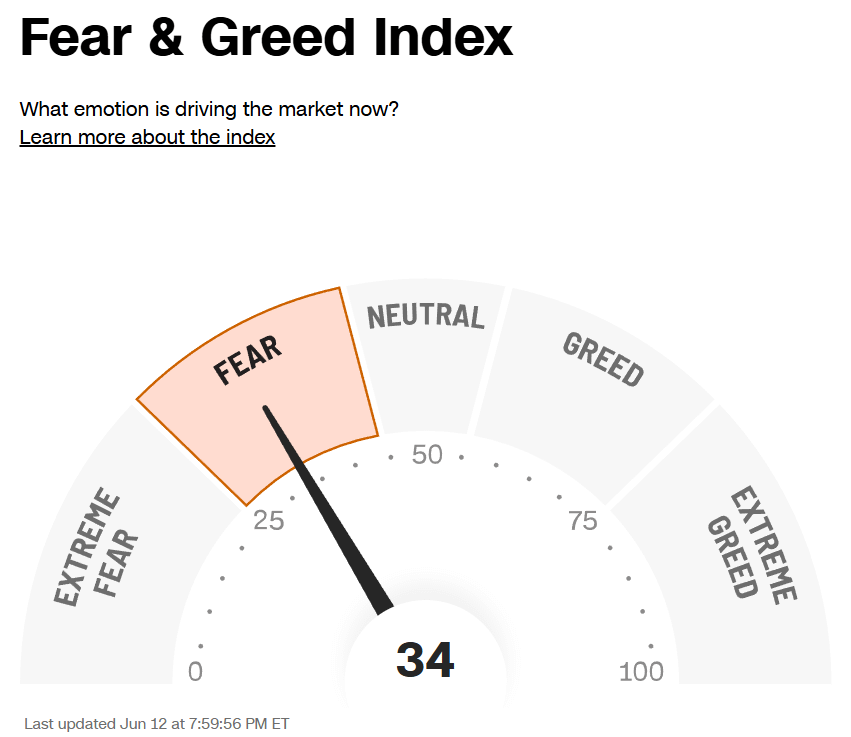
Ironically, the Fear & Greed Index reading above may give us grounds for cautious optimism. If it was showing Greed, I would be more worried.
Time will tell
Good luck!
Barney
If you’d like to discuss financial coaching, you can hit reply or set up an introductory call with me here.
You can save a life by sharing this article with a friend or family member